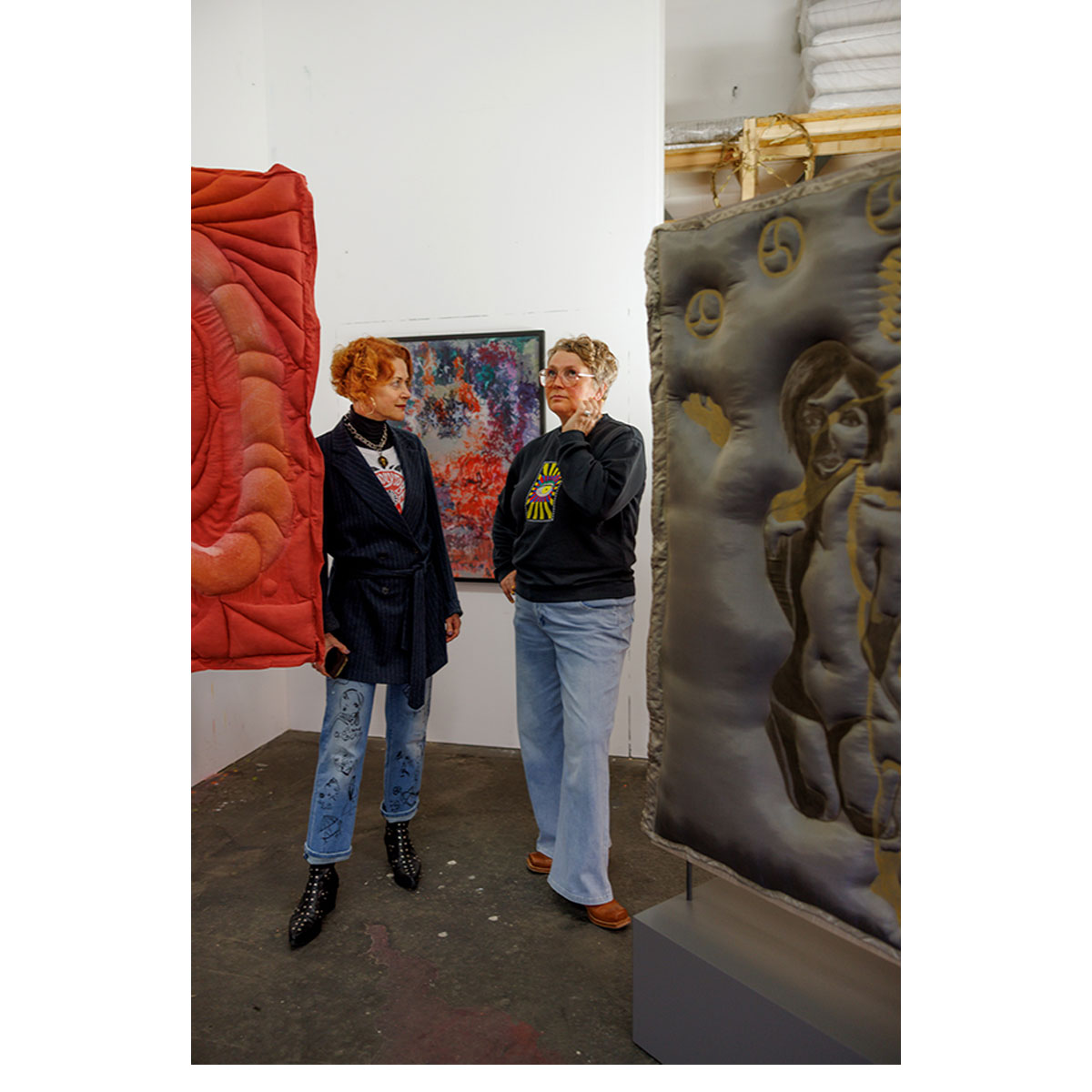
Text: Elke Backes, studio photographs: Carsten Sander
Berlin-Neukölln. Some art can be easily placed: a style, a medium, a signature—and it quickly fits into familiar categories. The works of Alex Müller do not. Each body of work stands on its own. And yet the question arises: is there a unifying bracket?

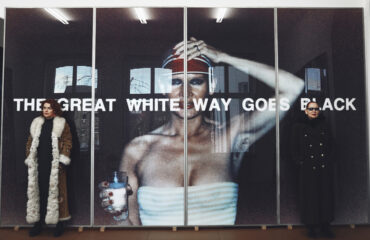
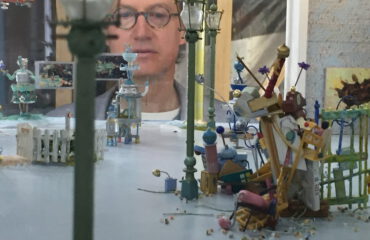
Examples of the diversity of works, photos: Rainer Kradisch; Bathtub Peas, top right: Jens Ziehe
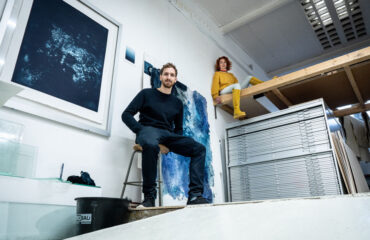
A visit to her studio provides initial clues. The space is used down to the last corner. Inserted walls, elevated structures, niches—a configuration of workshops, storage areas, and workspaces. Where painting usually takes place, Alex Müller has set up a small presentation. Drawings, painting, objects: materials, forms, and rhythms of color stand side by side without committing themselves.

In Alex Müller’s studio
Is this the result of radical openness? Or does this diversity follow a clear line of inquiry? With these questions, I begin our conversation.
“It is both,” replies Alex Müller. “My education at the Braunschweig University of Art encouraged exactly that: the free shifting between disciplines, the experimentation. At the same time, painting always remained my point of departure—especially at a time when its end was being proclaimed. ‘Put down the brush. Painting is dead!’—that was a sentence I had to deal with back then. For me, it meant above all one thing: contradiction.
E.B.: What inspired you in terms of content?
Alex: From very early on, I was drawn to things with a history or traces that have remained. I needed that certain dustiness, that sense of the past in my working environment. This included, for example, my passion for silent films, which ran on a continuous loop in the studio. Or books that provided models of thought. For instance, the idea of a modernist architect to assign each room its own floor. I was fascinated by the thought of what effect the different floor patterns must have on the inhabitants. Or, in a transferred sense, the question of how rhythm and structure influence our everyday lives. Much to my family’s dismay, I still live out this question by regularly rearranging our apartment [laughs].
E.B.: Were the things you worked with the classic “found objects” as known from art history?
Alex: No. Only later did I realize that they were always objects with a biographical connection. Objects whose story is actually complete, but whose ending I am not willing to accept. This becomes very clear in the letters that I presented as the installation “From Hand to Wall“at the Wilhelm Hallen. As long as I can remember, these letters were a topic in our home. Shortly before my father’s death, he arranged them again. It was therefore completely clear to me that I had to do something with them—something that would give them not only a special presence but also a timelessness, in a kind of vacuum.
E.B.: Please describe the installation with the letters once more.
Alex: My father fled from East Germany to West Berlin at the age of just 17. His parents suffered greatly from the separation and the lack of communication, which is reflected in 350 letters they wrote to him. Five years after my father’s death, I printed the letters—written 60 years ago in Wilhelmsruh, just 200 meters from the Wilhelm Hallen—onto cotton cushions and installed them closely side by side along a 25-meter-long wall. For me, the cushions, also in their shape, symbolize the vacuum described earlier, which intervenes in the process of transience.

Von der Hand an die Wand (From Hand to Wall), 2025 | Wilhelm Hallen, Berlin Art Week 2025; Fotos: Choreo
E.B.: Is this biographical connection also present in your painting?
Alex: Not as directly tangible, because I work very intuitively. Like for all of us, countless thoughts swirl around in my head, sometimes rising more, sometimes less to the surface. Certain events can provide the impulse. Let’s take this more recent work here: it is called Yesterday’s Heartbeat. While painting, I was thinking of a conversational situation and of this “dancing” in the mind that takes place. Of images that arise detached from what is being said and remain invisible to the other person. Often these are memories—which brings us back to the biographical connection—that I then transfer onto canvas using the means of painting and preserve.
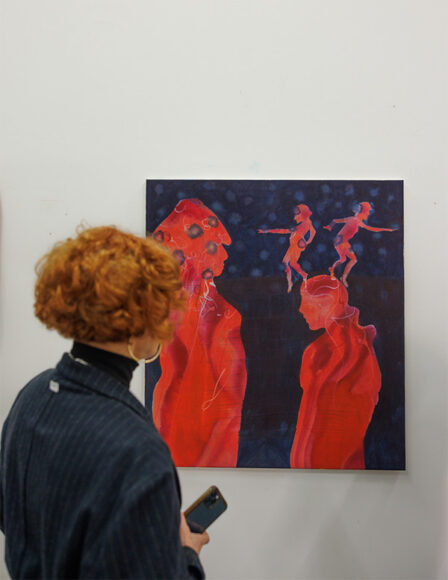
Das gestrige Herzklopfen (Yesterday’s Heartbeat), 2026
E.B.: Let’s move from motif to material. Why did you choose fabric here and attach the work to the wall in a hinge-like manner, almost like a window?
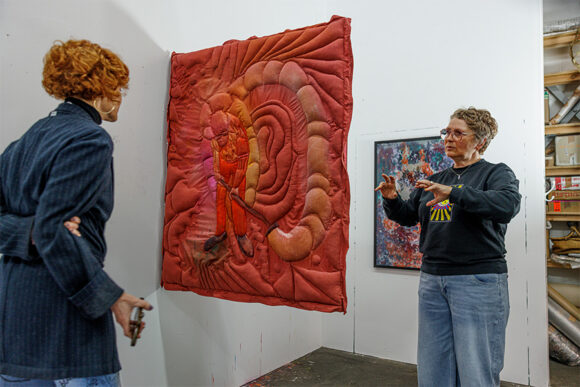
Endlich dick (Finally thick), 2023
Alex: As a child, I loved accompanying my grandfather to his doctor. I found the practice incredibly impressive: petrol-colored walls, brass fittings on the doors, refined furniture, and—what fascinated me completely—doors with Chesterfield upholstery. I think that was somewhere in my subconscious when I began this series of works. At the same time, there was the ongoing engagement with painting and the question of how I can break it open or extend it into space—through the mobility of the hinge, which also allows viewing from the back, or through the physicality of the work itself. Here, too, patterns emerge again, like in vacuum sealing—once again this holding onto images of thought.
E.B.: In the motif, a bent-over man with a broom can be seen, sweeping—again an everyday situation associated with order, structure, and rhythm. Alongside the biographical connection, are these also recurring elements?
Alex Müller: That is certainly the case. For me, sweeping symbolizes a kind of positive everyday reality. Overall, art is a reflection of what is closest to us. And that is everyday life—and our memories. Again and again, we are exposed to a flood of impressions that we try to reconcile with the images of our past. In this continuous process of ordering and structuring, much remains hidden in our subconscious. And it is often the small things that quite literally bring the forgotten back to the surface—like these objects that I place in a new context, or events that provide the impulse for a new work.
Perhaps this is exactly what holds the apparent diversity together, I think in conclusion. Not a style, not a material, not a motif—but a way of looking at what is close to us, and what remains of it.
Images of Thought. In the Vacuum of Memory.
Further Information
Website: http://www.karamelmuehle.de
Instagram: https://www.instagram.com/alexmueller_now/
Website Gallery: https://haverkampfleistenschneider.com/artists/alex-muller/
Upcoming exhibitions
June 27,2026: Neuer Kunstverein Mittelrhein, “Klammer auf wir” (gemeinsam mit Verena Issel)
September 2026: Kunstmuseum Wolfsburg
October 2026: Galerie Haferkamp Leistenschneider “Zeit ist jetzt”
December 13, 2026: Kunsthalle Memmingen “Alexandraplatz (auf Reise)”